Monday, February 24, 2014

Astronomer Biography Sources - Henrietta Leavitt

"Henrietta Leavitt." PBS. PBS, 1998. Web. <http://www.pbs.org/wgbh/aso/databank/entries/baleav.html>.

"1912: Henrietta Leavitt Discovers the Distance Key." Everyday Cosmology. Observatories of the Carnegie Institution for Science, n.d. Web. <http://cosmology.carnegiescience.edu/timeline/1912>.

"Henrietta Leavitt." Henrietta Leavitt. She Is an Astronomer, n.d. Web. <http://www.sheisanastronomer.org/index.php/history/henrietta-leavitt>.

"Henrietta Swan Leavitt - Lady of Luminosity." The Woman Astronomer. The Woman Astronomer, 01 Jan. 2008. Web. <http://www.womanastronomer.com/hleavitt.htm>.

Friday, February 14, 2014

APOD 3.5

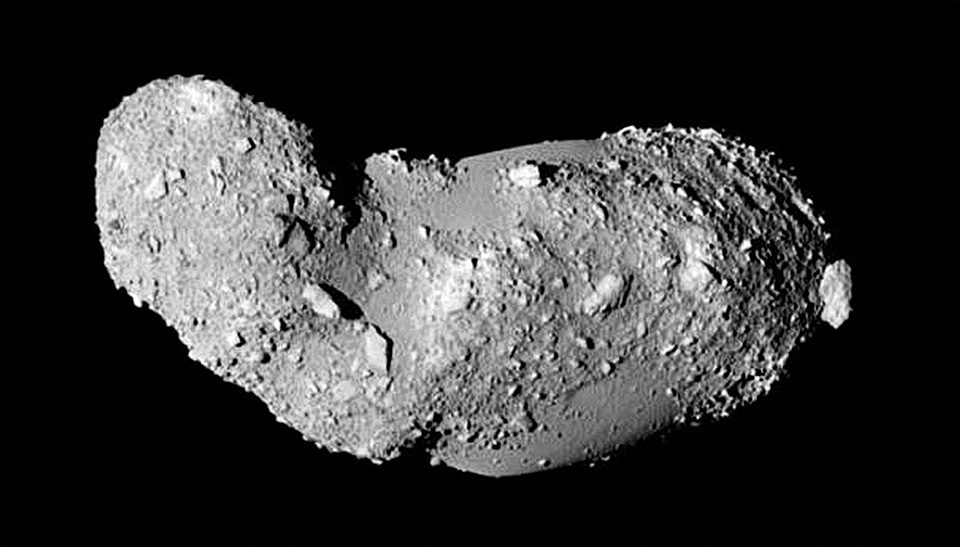
The image below shows Asteroid Itokawa. This image was taken by the Hayabusa spacecraft launched by Japan to better understand the composition of asteroids. In addition to taking images, the spacecraft determined the mass of the asteroid by measuring the attraction of the drifting Hayabusa spacecraft. Some of the composition of the asteroid were also studied with the debris from the impact of pellets fired from Hayabusa to Itokawa. The mysterious surface of the asteroid is astoundingly devoid of craters.One hypothesis to explain this oddity is that Itokawa is simply a floating mass of rock and ice chunks loosely held together by the weak gravitational force. If craters ever formed, the rocks and ice would merely settle in those places covering up the craters. Upon further research, astronomers discovered that one part of the interior of the asteroid Itokawa has a much higher average density than the other part.

Friday, February 7, 2014

APOD 3.4

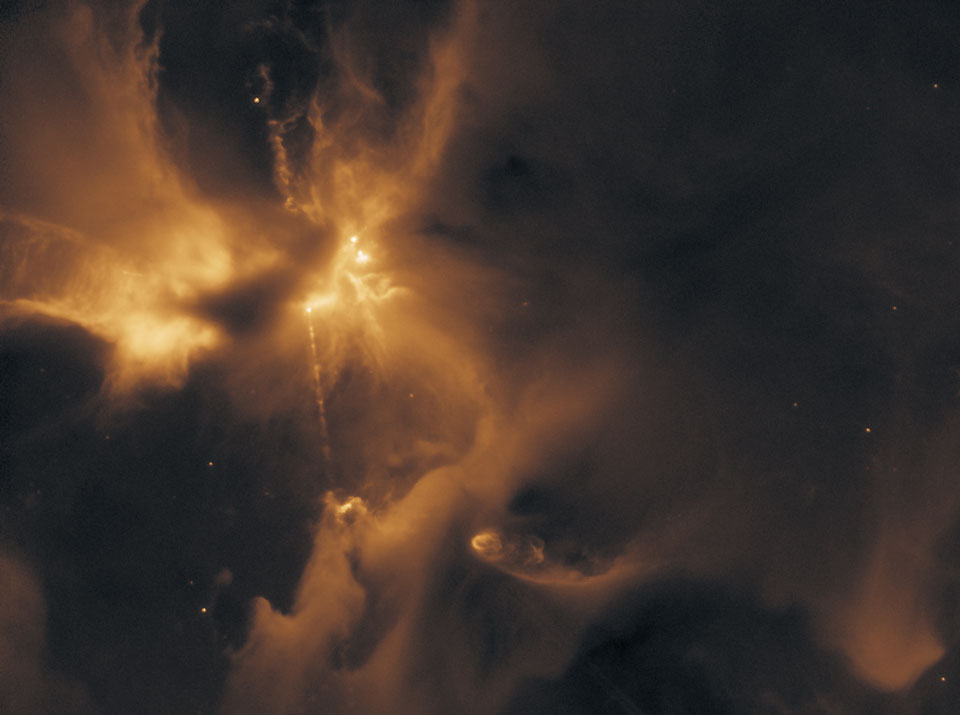
The image below is of Herbig-Haro object 24 taken by the Hubble Space Telescope in infrared light. Herbig-Haro objects are small patches of nebulosity associated with newly born stars. They are formed when thin jets of gas ejected by younger stars collide with clouds of dust and gas. Herbig-Haro objects are everywhere in star-forming regions and many form aorund a single star. Because of the rarity of them, astronomers estimate they only last a few thousand years. The star forming region is located 1,500 light years away from Earth in the Orion B molecular cloud complex. The jet in HH24 contains electrons and protons moving at hundreds of kilometers per second and it is studied to better understand young stellar objects (stars in the earliest stages of development). The dust and gas that encircles these baby stars often contribute to the formation of powerful jets.

Friday, January 31, 2014

APOD 3.3

The image below shows the spiral galaxy M83 (otherwise known as The Southern Pinwheel). This is one of the closest and brightest spiral galaxies in the sky. It is located in the constellation of Hydra (visible in April at 9 PM) and it is easily observed with binoculars. M83 is located 15 million light-years away. It is the perfect place to observe supernova remnants as well as the various stages of the stellar birth and death (spanning over 50,000 light-years). The newest generation of stars (roughly 1 million years old) are visible in large clusters at the edge of the spiral arms. The surrounding gas clouds absorb the ultraviolet light that these stars generate which gives the galaxy the spots of pink light. The stellar winds from the youngest, most massive stars blow away some of this gas revealing bright blue star clusters. The older stars in the galaxy appear yellow or orange.


Wednesday, January 29, 2014

Observation 3.2

Week of Jan 19 - Jan 25 (4 hr)
This week's stargaze  took place on clear, chilly night. We first observed Mercury which recently became visible in the night sky close to the horizon just after sunset. Ten degrees away, Fomalhaut, the brightest star in Pisces Austrinus was also visible among the trees. Given the favorable conditions, we were able to spot a few meteors as well as two Iridium flares from satellites. Using the telescope, we were able to observe Jupiter and its Galilean moons: Callisto, Io, Europa, and Ganymede. 
We also observed:
M42, the Orion Nebula, in the heart of the constellation of Orion. 
M45, Pleiades, the most visible cluster to the naked eye, located in the constellation of Taurus
M31, Andromeda Galaxy, next nearest spiral galaxy, located in the constellation of Andromeda

Friday, January 24, 2014

APOD 3.2

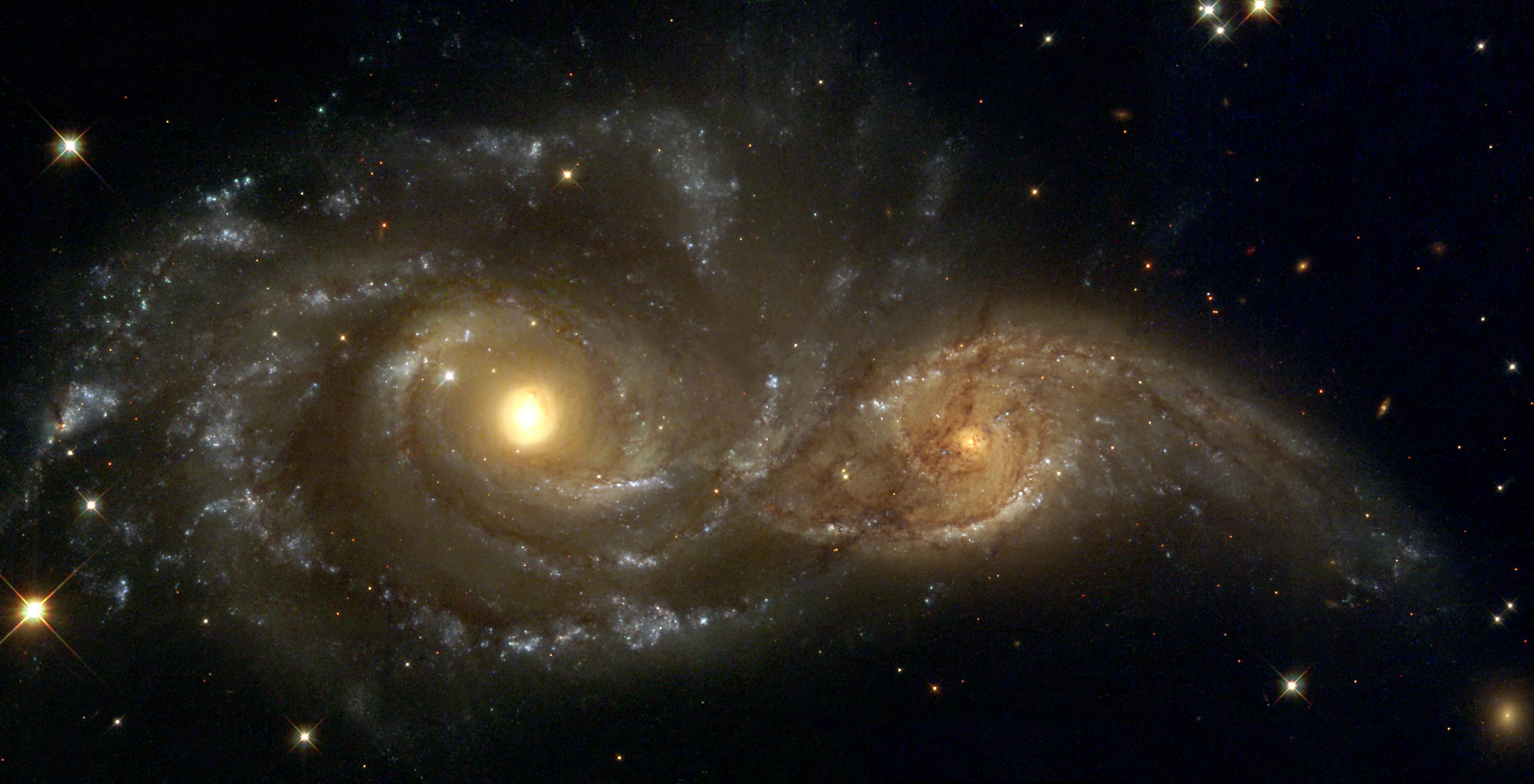
The image below shows two spiral galaxies, NGC 2207 and IC 2163 colliding into one another. In a few billions of years, one of these galaxies will emerge victorious and survive the collision. During the collision, these galaxies tear each other apart due to tidal forces, creating tides of matter. Shocked gas, dark dust, star formations and cast-away stars are all repercussions of this collision. Gravitational shock waves speed through both the galaxies and the resulting high pressures and high densities act as catalysts for star formation. These galaxies are so vast that during the collision, it very unlikely that any stars or objects will collide. Predictions favor NGC 2207 (pictured left) to engulf the smaller IC 2163 (pictured right).


Thursday, January 23, 2014

Observation 3.1

Week of Jan 12 - Jan 18 (1 hr)
I went out to stargaze on Saturday night; it was chilly, but the skies were clear and there weren't any clouds, bright lights, or other obstructions around me. Jupiter was clearly the brightest object in the sky besides the moon. I spotted Orion by finding the three stars that make up Orion's belt. Within the constellation, I found the contrasting stars of Betelgeuse and Rigel. The constellation of Taurus was in the middle of the sky and its brightest star, Aldebaran, could be clearly seen. I could also observe the constellations of Cassiopeia, Cepheus, Pegasus, Andromeda, and Aries. Because the sky was dark enough and I stayed outside for quite some time, I also spotted a total of three shooting stars, but I did not see any satellites.