Friday, April 11, 2014
APOD 4.3
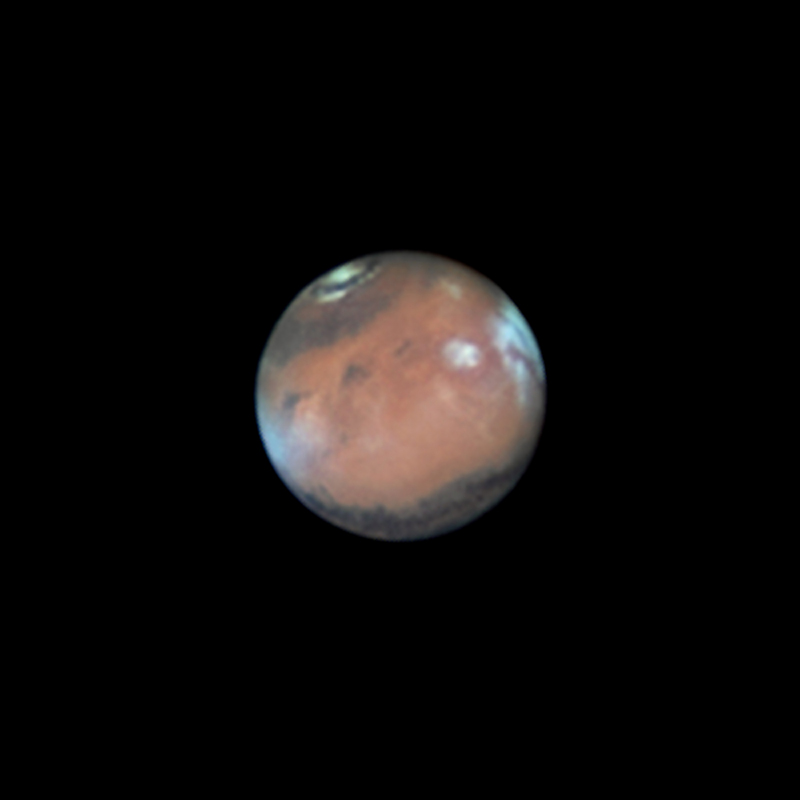
The image below shows Mars before it reaches opposition (which occurs on April 8th) and nearing its closest approach (which occurs on April 14th). This occurs roughly every 26 months. This image was taken using a high-speed digital camera and 16-inch diameter telescope located in Assis, Brazil. Mars is located in the constellation Virgo, opposite the Sun. It is unique in it's reddish color and can be found next to the faint Asteroid Vesta and dwarf planet Ceres. Mars rises in the east at sunset and can be found directly overhead by midnight shining almost 10 times brighter than a first magnitude star. Mars' north polar cap is visible in this image at the top left. The image also reveals whitish orographic clouds (large dense clouds that form over mountainous regions and remain over the tops of mountains; formed when moist air rises and reaches colder upper altitudes causing condensation). The 'mountains' over which these clouds rest is actually the largest volcano in the solar system (three times higher than Everest and fifty times the volume of Earth's largest volcano) named Olympus Mons.
Tuesday, April 8, 2014
Contributors to Determining the Structure of the Milky Way Galaxy
Galileo Galilei: Galileo was the first to point a telescope to the sky to discover that the glowing Milky Way was made up of billions of stars too faint to see individually with the naked eye. Galileo boldly declared: "It is nothing else but a mass of innumerable stars planted together in clusters." This officially disproved Aristotle's earlier prediction that the glow of the Milky Way was a phenomenon of Earth's atmosphere.
William Herschel: In the late 1700s, William Herschel attempted to map out the Milky Way. His greatest setback was not being able to accurately determine the distances between stars. Regardless, he used a large reflecting telescope to produce the first General Catalog of galaxies.
Harlow Shapley: In the early 20th century, Shapely refined, Herschel's method to estimate that the Milky Way was a disc containing billions of stars and was tens or hundreds of light years across. He was particularly interested in the distribution of globular clusters within the Milky Way. Using the period-luminosity relation, Shapley determined the distances to globular clusters. Shapley found that the globular clusters form a near sphere around a point in the constellation of Sagittarius. He reasoned that this point is the center of the galaxy which he placed at a distance of 30,000 parsecs. (His distance measurements were obscured by dust clouds that decrease the luminosity of RR Lyrae stars- the modern distance is 8,000 parsecs.
Edwin Hubble: Edwin Hubble identified Cepheids in Andromeda and he derived distances even greater than those that Shapley predicted. Edwin Hubble proved that the Milky Way Galaxy did not make up the entire universe, but was merely one in a myriad of galaxies that make up the universe.
RR Lyrids and Cepheids: The period over which a Cepheid variable star fluctuates is related to its brightness (or luminosity). By measuring the period of these fluctuations, one can determine the brightness of the star. By comparing the observed brightness to the intrinsic brightness, the distance to the star can be calculated. Shapley used this method to determine the distances to clusters, while Curtis did not believe this to be an accurate method of measurement.
Immanuel Kant: In the late 18th century, Immanuel Kant speculated that the Milky Way consisted of a huge number of stars all rotating a common center. One of those stars as our very own Sun. These stars are held together in orbits around a common center by strong gravitational forces. Kant is correct in all of his hypotheses.
Henrietta Leavitt: Leavitt discovered the Period-luminosity relationship for Cepheid variable stars that allows astronomers to determine the distances of stars. Shapley used this method to determine the distances of globular clusters near the center of the Milky Way. Refer to Henrietta Leavitt Biography entry in this blog for more information.
The Great Debate: The Great Debate took place in 1920 and was officially dubbed: Shapley v. Curtis and the Scale of the Universe. The main questions they discussed were: "What is the nature of the nebulae?," "What is the size of our Galaxy?," and "Is the Sun in the center of the Galaxy?" Shapley believed that the diameter of our Galaxy was 300,000 light-years and that the Sun was not at the Galaxy's center but 60,000 light-years away. He also believed that the Milky Way was so large, it was the entire universe and that spiral nebulae were gaseous clouds repelled by the Milky Way's light pressure. Curtis believed that the diameter of the Galaxy was 30,000 light-years (ten times smaller than Shapley's prediction). He also believed that the sun was very close or at the center of the Galaxy and that spiral nebulae were galaxies (island universes). There was no clear winner in the debate because both were correct on one major point and incorrect on another. Both were incorrect in saying that interstellar absorption of starlight by dust is unimportant.
William Herschel: In the late 1700s, William Herschel attempted to map out the Milky Way. His greatest setback was not being able to accurately determine the distances between stars. Regardless, he used a large reflecting telescope to produce the first General Catalog of galaxies.
Harlow Shapley: In the early 20th century, Shapely refined, Herschel's method to estimate that the Milky Way was a disc containing billions of stars and was tens or hundreds of light years across. He was particularly interested in the distribution of globular clusters within the Milky Way. Using the period-luminosity relation, Shapley determined the distances to globular clusters. Shapley found that the globular clusters form a near sphere around a point in the constellation of Sagittarius. He reasoned that this point is the center of the galaxy which he placed at a distance of 30,000 parsecs. (His distance measurements were obscured by dust clouds that decrease the luminosity of RR Lyrae stars- the modern distance is 8,000 parsecs.
Edwin Hubble: Edwin Hubble identified Cepheids in Andromeda and he derived distances even greater than those that Shapley predicted. Edwin Hubble proved that the Milky Way Galaxy did not make up the entire universe, but was merely one in a myriad of galaxies that make up the universe.
RR Lyrids and Cepheids: The period over which a Cepheid variable star fluctuates is related to its brightness (or luminosity). By measuring the period of these fluctuations, one can determine the brightness of the star. By comparing the observed brightness to the intrinsic brightness, the distance to the star can be calculated. Shapley used this method to determine the distances to clusters, while Curtis did not believe this to be an accurate method of measurement.
Immanuel Kant: In the late 18th century, Immanuel Kant speculated that the Milky Way consisted of a huge number of stars all rotating a common center. One of those stars as our very own Sun. These stars are held together in orbits around a common center by strong gravitational forces. Kant is correct in all of his hypotheses.
Henrietta Leavitt: Leavitt discovered the Period-luminosity relationship for Cepheid variable stars that allows astronomers to determine the distances of stars. Shapley used this method to determine the distances of globular clusters near the center of the Milky Way. Refer to Henrietta Leavitt Biography entry in this blog for more information.
The Great Debate: The Great Debate took place in 1920 and was officially dubbed: Shapley v. Curtis and the Scale of the Universe. The main questions they discussed were: "What is the nature of the nebulae?," "What is the size of our Galaxy?," and "Is the Sun in the center of the Galaxy?" Shapley believed that the diameter of our Galaxy was 300,000 light-years and that the Sun was not at the Galaxy's center but 60,000 light-years away. He also believed that the Milky Way was so large, it was the entire universe and that spiral nebulae were gaseous clouds repelled by the Milky Way's light pressure. Curtis believed that the diameter of the Galaxy was 30,000 light-years (ten times smaller than Shapley's prediction). He also believed that the sun was very close or at the center of the Galaxy and that spiral nebulae were galaxies (island universes). There was no clear winner in the debate because both were correct on one major point and incorrect on another. Both were incorrect in saying that interstellar absorption of starlight by dust is unimportant.
Friday, April 4, 2014
APOD 4.2
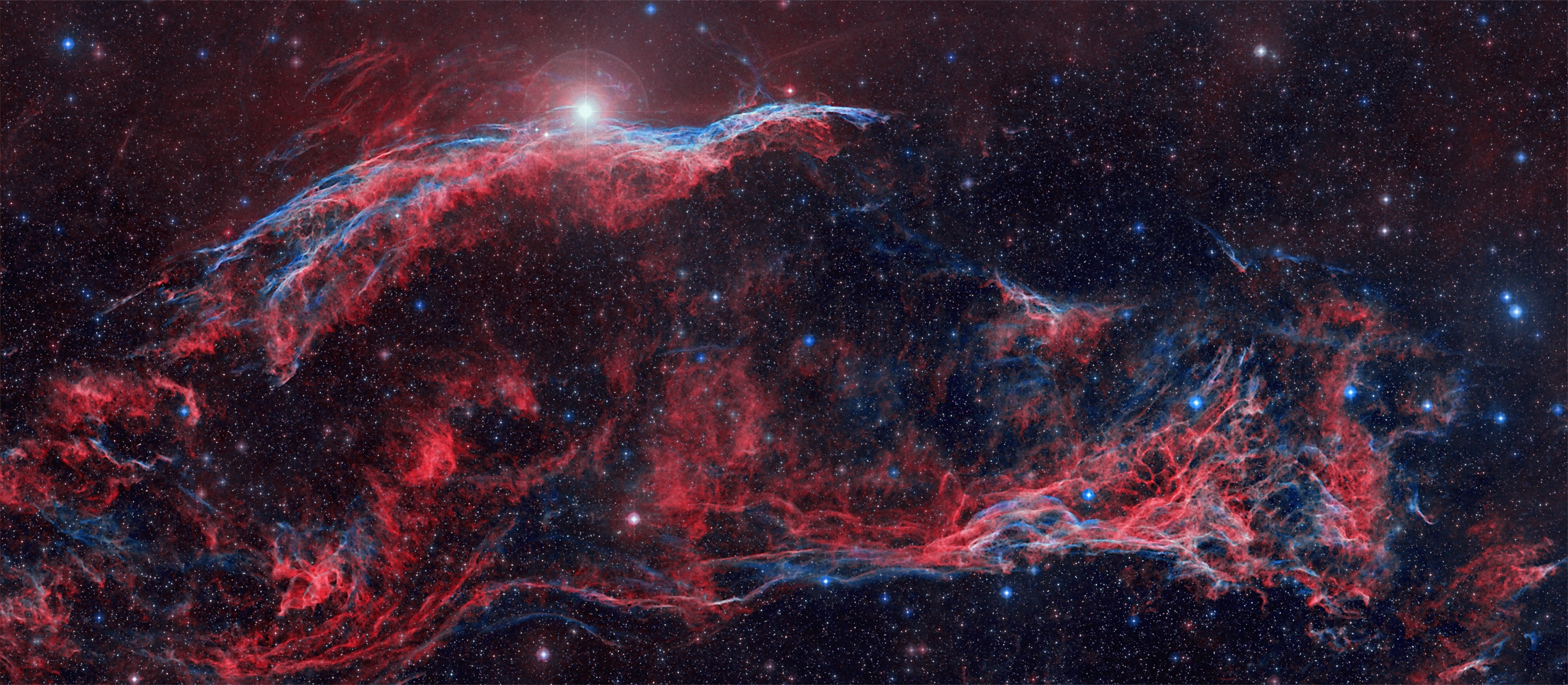
The image below is one of the Veil Nebula, also known as the Cygnus Loop, located in the constellation of Cygnus 1,500 light-years away from Earth. It spans about 6 times the diameter of a full moon across the night sky (approximately 3 degrees). This translates to about 70 light-years across. The Veil Nebula is a supernova remnant. The gas and filaments of dust are still expanding from the massive explosion signaling the death of a star. The light from the supernova originally reached Earth about 5,000 years ago. The glowing gas is a result of the shock waves from the explosion of the star traveling through and exciting interstellar material. The red portrays atomic hydrogen and the blue portrays oxygen gas. The brightest portions of the Nebula are regarded as separate nebulae such as The Witch's Broom (along the top) and Pickering's Triangle (bottom right off-center).
Thursday, March 27, 2014
APOD 4.1
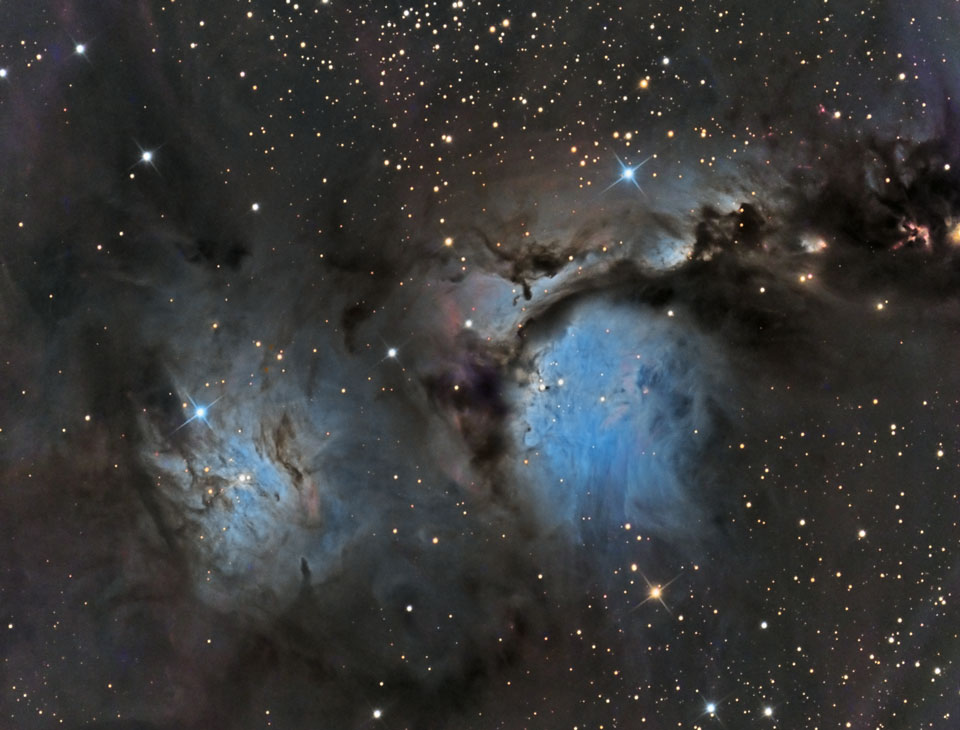
The image below is one of the constellation of Orion and M78 as well as other bright reflection nebula in the constellation. These include The Witch Head Nebula, Nebula NGC 1435 and Nebula NGC 1999. M78 and NGC 2078 are pictured below while the other reflection nebulae are not. M78 is five light years across and can be observed through a small telescope. M78 is contained in Orion's Molecular Cloud Complex that also contains the Great Nebula in Orion and the Horsehead Nebula. The fractal interstellar dust surrounding these nebulae absorbs light and also reflects the light of recently formed blue stars in the nebula. The same type of light scattering that occurs in our daytime sky occurs in this image creating the bluish hues portrayed in the image.
Thursday, March 6, 2014
Henrietta Swan Leavitt Biography
Just a
little over a century ago, astronomer Henrietta Swan Leavitt made a remarkable
discovery. Her discovery became a keystone in shaping modern astronomy.
However, she was acclaimed only posthumously; she had no reward nor recognition
from her peers for her amazing discovery.
Henrietta
Swan Leavitt was born in Cambridge, Massachusetts in 1869. She was the daughter
of a Congregational minister which led to her strong role in her church and community.
She followed a rigorous course of education from a young age. At age 20 she
entered Radcliffe College and studied a broad variety of subjects: classical
Greek, fine arts, philosophy, analytical geometry and differential calculus.
Her advanced course work and exceptional achievements at school were enough to
build a solid foundation for a successful career at school. Several years after
graduation, she fell ill and her serious illness left her almost completely
deaf. As she recovered from her illness she volunteered at the Harvard College
Observatory and seven years later (1893) she was granted employment. However, at
the time Henrietta entered the workforce, women were subjected to the prejudice
that men were superior. She was labeled as a lowly book-keeping 'computer' in charge of cataloguing the
brightness of stars. She earned a mere 25 cents an hour- the pay of a servant. She
surpassed the qualifications to be hired as an astronomer or even a junior
astronomical researcher, yet she was held back from her full potential because
of her gender. She worked in a tight quarters with other female astronomers in a
similar position under the leadership of Edward Pickering who "chose his
staff to work, not to think" (Payne, AAVSO).
Early
in her career, Leavitt focused on Cepheid variables, a type of star that varies
between larger, brighter states and smaller, dimmer ones. Even having
personally discovered 2,400 (about half of the known total in her day) new
variable stars, she received little recognition. Leavitt is also credited with
the development of the Harvard Standard, a standard of photographic
measurements that was officially accepted by the International Committe on
Photographic Magnitudes in 1913. Her most remarkable recognition (1912) occurred
while she was recording the various data on her Cepheid variables. She found an
accurate and consistent relationship between the period of a given star's
brightness and its absolute magnitude. This simple relationship made it
possible, for the first time, to accurately measure stars' distances from
Earth. Leavitt's discovery was published under Edward Pickering's name, making
only one reference to Leavitt as the person who had simply 'prepared' the data.
Leavitt's discovery catalyzed many more discoveries in the astronomical
community. Many famous astronomers such as Edwin Hubble and Ejnar Hertzsprung
would not have been able to make their contributions to astronomy without
Leavitt's discovery.
Little
is known about Leavitt's personal life as she left behind no diaries or
memoires and she kept mostly to herself. Her peers remembered her as having a
shy disposition so no one could tell how she dealt the frustrations of her debasement
because of her gender. However, one of her peers described her as
"possessing the best mind at the Observatory" (PBS). She lived so quietly that her death in 1921 went almost
completely unnoticed. In 1925 the Swedish mathematician Gösta Mittlag-Leffler
wrote her a letter nominating her for the Nobel Prize in Physics for 1926. He
was completely unaware that she had passed away four years ago and Harlow
Shapley, Pickering's successor attempted to steal her Nobel Prize by replying to
Mittlag-Leffler taking credit for Leavitt's discovery.
Even today, Henrietta Leavitt's name is not as recognized as it should be considering her discovery radically changed modern astronomy. Her only lasting recognition is a minor lunar crater and a virtual space theatre that bear Henrietta Swan Leavitt's name. One can only hope that the day will come when Henrietta Leavitt receives the recognition she deserves.
Subscribe to:
Posts (Atom)