Thursday, May 22, 2014

Ring Nebula

Processed using "LOG". The first image is a normal combination of the color enhanced images with the red, blue, and green filters.

Lagoon Nebula

Processed using "LINEAR". The first image is a normal combination of the color enhanced images with the red, blue, and green filters.

Eagle Nebula

Processed using "LINEAR". The first image is a normal combination of the color enhanced images with the red, blue, and green filters.

Dumbbell Nebula

Processed using "LOG". The first image is a normal combination of the color enhanced images with the red, blue, and green filters.

Andromeda Galaxy

Processed using "LOG". The first image is a normal combination of the color enhanced images with the red, blue, and green filters.

Friday, May 16, 2014

APOD 4.8

Below is a live feed of what an observer on the International Space Station might see. Two weeks ago, the SpaceX Dragon capsule, an unmanned reusable spacecraft owned by a private American space transportation company, delivered, among other supplies, a High Definition Earth Viewing (HDEV) system capable of transmitting live views of Earth as the International Space Station orbits the planet. The live feed switches between four cameras all pointed in different directions. The transition into darkness signifies the transition from day into night. This night only lasts 45 minutes because of the International Space Station's short ninety minute orbit.

Wednesday, May 14, 2014

Astronomer Biography - George O. Abell

     George O. Abell was born in Los Angeles in 1927 to Unitarian minister Theodore C. Abell and Annamarie Ogden. He was first inspired to pursue the field of astronomy at the age of eight when his father took him to the Griffith Planetarium. Lectures by Clarence Cleminshaw and books from his grandfather's vast library all helped captivate his interest in the field of science and mathematics. Abell kept himself busy maintaining multiple part-time jobs while he was still in high school. Once he graduated from high school in 1945 he volunteered in the Army Air Corps. At the end of the war, he became a weather observer and got sent to Japan. After a total of eighteen months of service he was discharged as a sergeant. After returning to California he took and passed all of the Cal Tech entrance exams and was enrolled the following fall. Paying for his education with the GI Bill, he pursued his passions for astronomy his sophomore year when the astronomy department opened its doors.
      Abell began his official astronomical career as a tour guide at the Griffith Observatory in Los Angeles and later proceeded as an observer on the Palomar Observatory Sky Survey. Abell is best known for his work in the cataloging of clusters of galaxies during the Palomar Sky Survey. He identified and described many clusters of galaxies and his collection is the foundation and reference point in this field. He created the basis around which observational cosmology revolves. In it he analyzed galaxy cluster formation and evolution, demonstrated that second-order clustering existed, and collated a fmaous list of 86 planetary nebulae in 1966. Some of his studies from observations included the luminosity function: the relationship between luminosity and the number of cluster members in each brightness interval. While working on the Palomar survey plates, Abell discovered several dim and aged gaseous nublae called planetaries. With the collaboration of Peter Goldreich at UCLA, Abell concluded that planetary nebulae must have evolved from red giant stars which had previously evolved from ordinary solar type stars. His conclusion matches the current accepted view. The "Abell Clusters" of galaxies he discovered are the largest known structures in the universe.
     Abell was chairman of the American Astronomical Society Education Committee and he was a visiting lecturer at many small colleges that lacked astronomy departments. Collaborating with Julian Schwinger, Abell played a crucial part in writing and producing a 16-part TV series titled Understanding Space and Time. This program shaped him into a true popularizer of science and education. He used this program to reach out to others who were not able to pursue astronomy at their schools or colleges. He also addressed and exposed pseudo-science and astrology as frauds. Because of his work with this program, he was also featured in Skeptical Inquirer.
     Abell passed away October 7, 1983 just as he was about to be appointed the editor of the Astronomical Journal. Asteroid 3449 Abell and The George Abell Observatory in Milton Keynes, England are named in his honor.

Tuesday, May 13, 2014

Astronomer Biography Sources

Epps, H. "George O. Abell, Astronomy: Los Angeles." University of California: In Memoriam, 1985.     California Digital Library, n.d. Web. <http://content.cdlib.org/view?docId=hb4d5nb20m&doc.view=content&chunk.id=div00002&toc.depth=1&brand=calisphere&anchor.i=0>.

"George O. Abell - Astronomer, Educator, Sceptic." Space Theology (Astrotheology). N.p., 8 Oct. 2012. Web. <http://spacetheology.blogspot.com/2012/10/george-o-abell-astronomer-educator.html>.

Friday, May 9, 2014

APOD 4.7

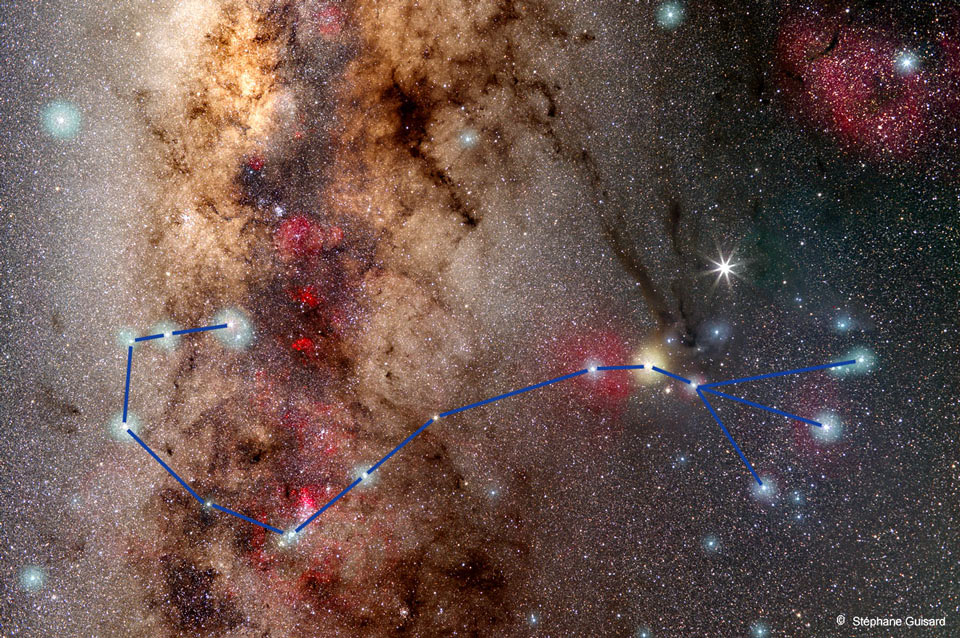
The image below features a summer zodiacal constellation: Scorpius. This image was taken with a specialized camera using optical filters and later processed with a digital image processor. The high detail in the photograph was achieved with a series of long exposures taken in several colors but only one exposure in a specific hue of red that signifies hydrogen. Part of the plane of the Milky Way is visible across the left side of the image. The dark dust bands in the center of the image are known as Dark River. The Dark River connects the Pipe Nebula to the colorful region near Antares. The Dark River is located about 500 light years away and spans nearly 10 degrees across the sky in the constellation of Scorpius. 


Friday, May 2, 2014

APOD 4.6

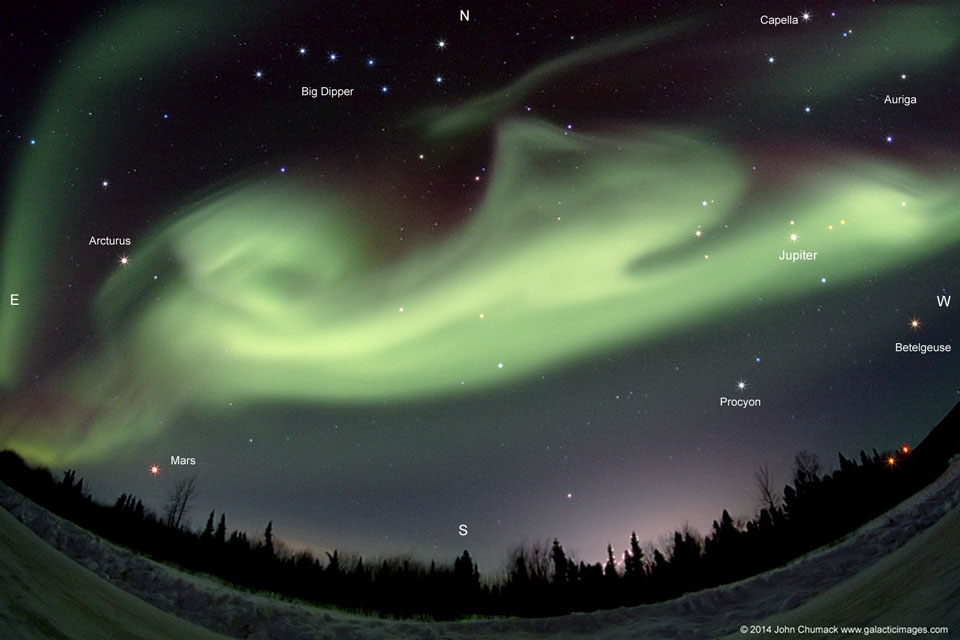
Astrophotographer John Chumack captured an amazing and unusual photograph of an aurora. This photograph was taken near Fairbanks, Alaska during his annual aurora tour. The aurora's shape stands out the most as it looks like a leaping dog complete with ears, a head, and even a curly tail. Using a wide-angle lens coupled with 15 seconds of exposure he captured not only this unique aurora, but also various highlights of the night sky. Jupiter can be seen through the dog's front legs and Mars can be seen between the dog's hind legs.Other notable features include the Big Dipper, Betelgeuse, Arcturus, and Capella. 


Friday, April 25, 2014

APOD 4.5

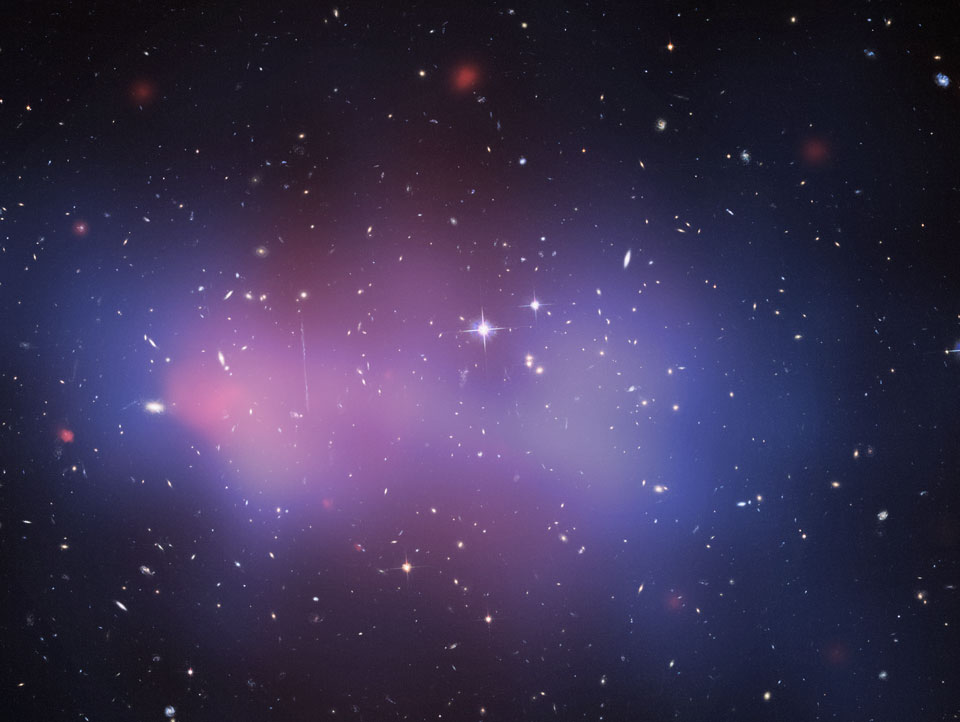
The image below depicts the galaxy cluster, El Gordo (literally translated to The Fat One) aka ACT-CL J0102-4915. This is the largest distant galaxy cluster to ever have been discovered and observed. It is located approximately 7 billion light-years from Earth. It was found by NASA's Chandra X-ray Observatory. This cluster is the most massive (has the mass of a million billion Suns) and hottest and gives off the most X-rays of any known cluster at this distance and beyond. This cluster is  composed of two separate galaxy subclusters that are currently colliding at several million kilometers per hour. The pinkish hue in the image is the hot gas and a computer generated map shows the most probably distribution of dark matter in blue. This distribution was calculated using the gravitational lens distortions of background galaxies. 

Thursday, April 17, 2014

APOD 4.4

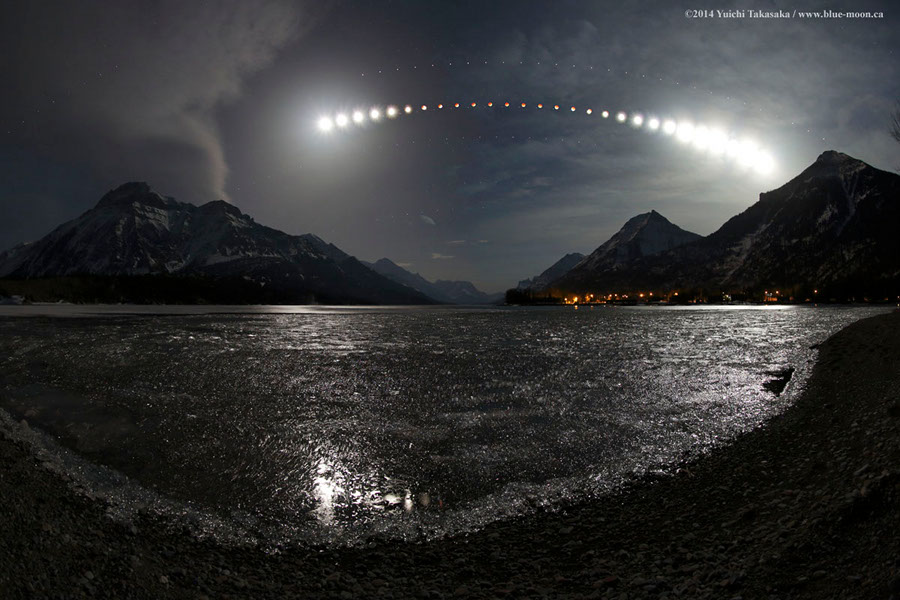
This sequence of images below was taken early Tuesday morning in Waterton Lakes National Park in Alberta, Canada. The peaks in the distance are also part of Glacier National Park, Montana. A series of photographs of the moon shows the progression of a total lunar eclipse- 2014's first. The lunar eclipse was visible for everyone in the Western Hemisphere to enjoy. Each photograph was taken ten minutes apart and captures the entirety of the total phase of the eclipse (which lasted a total of 80 minutes). The image also shows the progression of Spica and Mars across the night sky. Aristarchus, a Greek Astronomer around 270 B.C., was the first to measure the duration of a lunar eclipse (without the aid of modern technology) using simple geometry.

Friday, April 11, 2014

MicroObservatory Trifid Nebula

Processed using "LOG". The first image is a normal combination of the color enhanced images with the red, blue, and green filters.

APOD 4.3

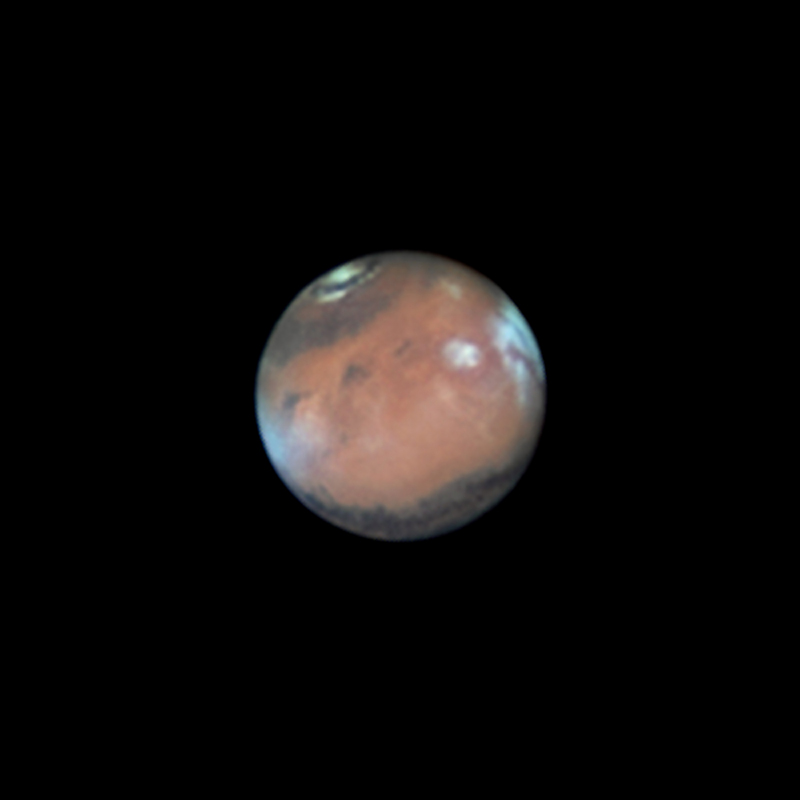
The image below shows Mars before it reaches opposition (which occurs on April 8th) and nearing its closest approach (which occurs on April 14th). This occurs roughly every 26 months. This image was taken using a high-speed digital camera and 16-inch diameter telescope located in Assis, Brazil. Mars is located in the constellation Virgo, opposite the Sun. It is unique in it's reddish color and can be found next to the faint Asteroid Vesta and dwarf planet Ceres. Mars rises in the east at sunset and can be found directly overhead by midnight shining almost 10 times brighter than a first magnitude star. Mars' north polar cap is visible in this image at the top left. The image also reveals whitish orographic clouds (large dense clouds that form over mountainous regions and remain over the tops of mountains; formed when moist air rises and reaches colder upper altitudes causing condensation). The 'mountains' over which these clouds rest is actually the largest volcano in the solar system (three times higher than Everest and fifty times the volume of Earth's largest volcano) named Olympus Mons.


Tuesday, April 8, 2014

Contributors to Determining the Structure of the Milky Way Galaxy

Galileo Galilei: Galileo was the first to point a telescope to the sky to discover that the glowing Milky Way was made up of billions of stars too faint to see individually with the naked eye. Galileo boldly declared: "It is nothing else but a mass of innumerable stars planted together in clusters." This officially disproved Aristotle's earlier prediction that the glow of the Milky Way was a phenomenon of Earth's atmosphere.

William Herschel: In the late 1700s, William Herschel attempted to map out the Milky Way. His greatest setback was not being able to accurately determine the distances between stars. Regardless, he used a large reflecting telescope to produce the first General Catalog of galaxies. 

Harlow Shapley: In the early 20th century, Shapely refined, Herschel's method to estimate that the Milky Way was a disc containing billions of stars and was tens or hundreds of light years across. He was particularly interested in the distribution of globular clusters within the Milky Way. Using the period-luminosity relation, Shapley determined the distances to globular clusters. Shapley found that the globular clusters form a near sphere around a point in the constellation of Sagittarius. He reasoned that this point is the center of the galaxy which he placed at a distance of 30,000 parsecs. (His distance measurements were obscured by dust clouds that decrease the luminosity of RR Lyrae stars- the modern distance is 8,000 parsecs.

Edwin Hubble: Edwin Hubble identified Cepheids in Andromeda and he derived distances even greater than those that Shapley predicted. Edwin Hubble proved that the Milky Way Galaxy did not make up the entire universe, but was merely one in a myriad of galaxies that make up the universe. 

RR Lyrids and Cepheids: The period over which a Cepheid variable star fluctuates is related to its brightness (or luminosity). By measuring the period of these fluctuations, one can determine the brightness of the star. By comparing the observed brightness to the intrinsic brightness, the distance to the star can be calculated. Shapley used this method to determine the distances to clusters, while Curtis did not believe this to be an accurate method of measurement. 

Immanuel Kant: In the late 18th century,  Immanuel Kant speculated that the Milky Way consisted of a huge number of stars all rotating a common center. One of those stars as our very own Sun. These stars are held together in orbits around a common center by strong gravitational forces. Kant is correct in all of his hypotheses. 

Henrietta Leavitt: Leavitt discovered the Period-luminosity relationship for Cepheid variable stars that allows astronomers to determine the distances of stars. Shapley used this method to determine the distances of globular clusters near the center of the Milky Way. Refer to Henrietta Leavitt Biography entry in this blog for more information.

The Great Debate: The Great Debate took place in 1920 and was officially dubbed: Shapley v. Curtis and the Scale of the Universe. The main questions they discussed were: "What is the nature of the nebulae?," "What is the size of our Galaxy?," and "Is the Sun in the center of the Galaxy?" Shapley believed that the diameter of our Galaxy was 300,000 light-years and that the Sun was not at the Galaxy's center but 60,000 light-years away. He also believed that the Milky Way was so large, it was the entire universe and that spiral nebulae were gaseous clouds repelled by the Milky Way's light pressure. Curtis believed that the diameter of the Galaxy was 30,000 light-years (ten times smaller than Shapley's prediction). He also believed that the sun was very close or at the center of the Galaxy and that spiral nebulae were galaxies (island universes). There was no clear winner in the debate because both were correct on one major point and incorrect on another. Both were incorrect in saying that interstellar absorption of starlight by dust is unimportant. 

Friday, April 4, 2014

MicroObservatory Crab Nebula

Processed using "LOG". The first image is a normal combination of the color enhanced images with the red, blue, and green filters. The second image is enhanced using the "FIRE" filter.


APOD 4.2

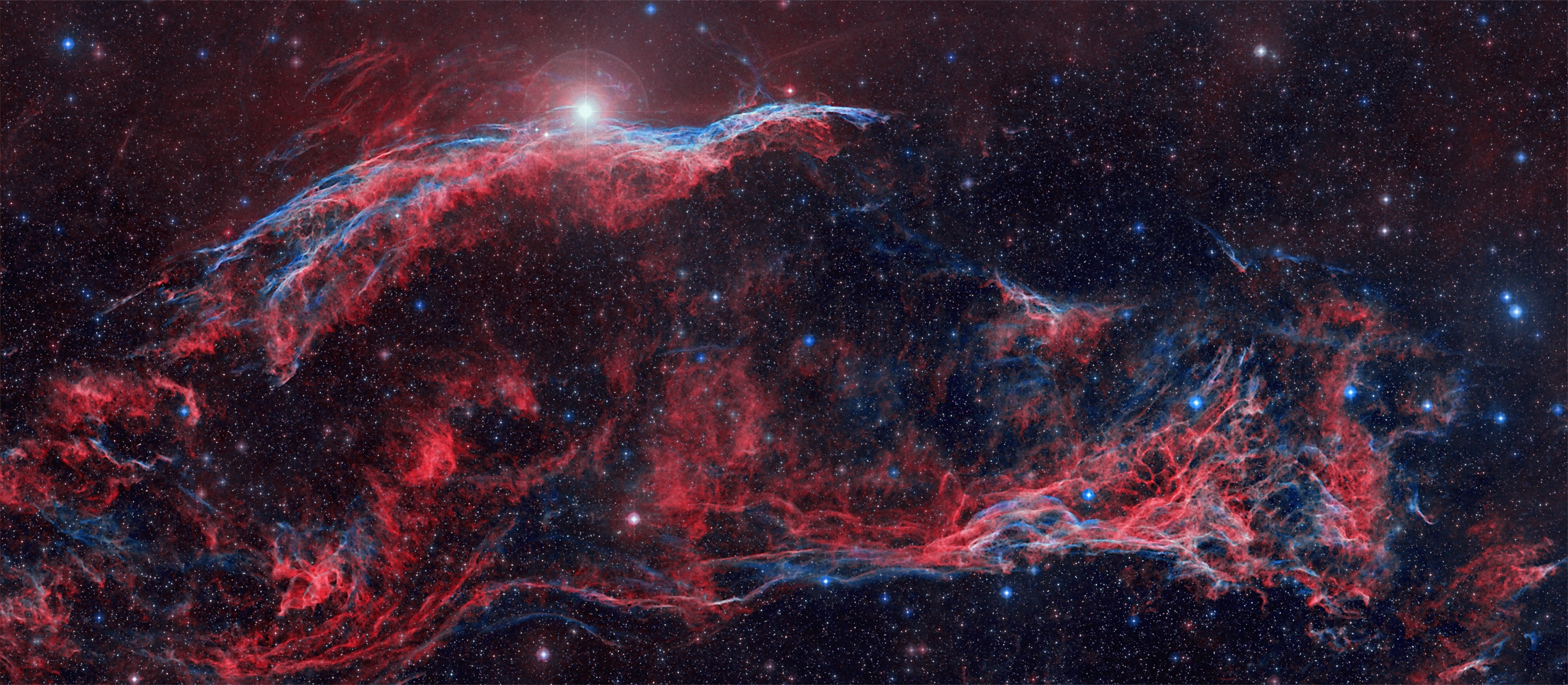
The image below is one of the Veil Nebula, also known as the Cygnus Loop, located in the constellation of Cygnus 1,500 light-years away from Earth. It spans about 6 times the diameter of a full moon across the night sky (approximately 3 degrees). This translates to about 70 light-years across. The Veil Nebula is a supernova remnant. The gas and filaments of dust are still expanding from the massive explosion signaling the death of a star. The light from the supernova originally reached Earth about 5,000 years ago. The glowing gas is a result of the shock waves from the explosion of the star traveling through and exciting interstellar material. The red portrays atomic hydrogen and the blue portrays oxygen gas. The brightest portions of the Nebula are regarded as separate nebulae such as The Witch's Broom (along the top) and Pickering's Triangle (bottom right off-center).

Thursday, March 27, 2014

APOD 4.1

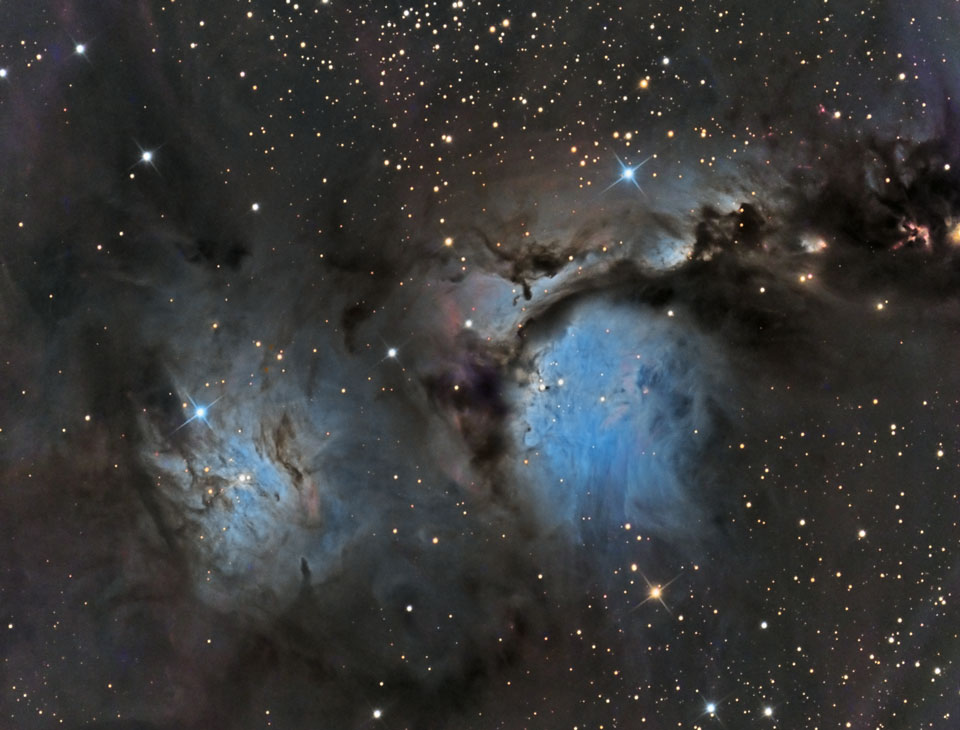
The image below is one of the constellation of Orion and M78 as well as other bright reflection nebula in the constellation. These include The Witch Head Nebula, Nebula NGC 1435 and Nebula NGC 1999. M78 and NGC 2078 are pictured below while the other reflection nebulae are not. M78 is five light years across and can be observed through a small telescope. M78 is contained in Orion's Molecular Cloud Complex that also contains the Great Nebula in Orion and the Horsehead Nebula. The fractal interstellar dust surrounding these nebulae absorbs light and also reflects the light of recently formed blue stars in the nebula. The same type of light scattering that occurs in our daytime sky occurs in this image creating the bluish hues portrayed in the image. 

Thursday, March 6, 2014

Henrietta Swan Leavitt Biography

                Just a little over a century ago, astronomer Henrietta Swan Leavitt made a remarkable discovery. Her discovery became a keystone in shaping modern astronomy. However, she was acclaimed only posthumously; she had no reward nor recognition from her peers for her amazing discovery.

                Henrietta Swan Leavitt was born in Cambridge, Massachusetts in 1869. She was the daughter of a Congregational minister which led to her strong role in her church and community. She followed a rigorous course of education from a young age. At age 20 she entered Radcliffe College and studied a broad variety of subjects: classical Greek, fine arts, philosophy, analytical geometry and differential calculus. Her advanced course work and exceptional achievements at school were enough to build a solid foundation for a successful career at school. Several years after graduation, she fell ill and her serious illness left her almost completely deaf. As she recovered from her illness she volunteered at the Harvard College Observatory and seven years later (1893) she was granted employment. However, at the time Henrietta entered the workforce, women were subjected to the prejudice that men were superior. She was labeled as a lowly book-keeping  'computer' in charge of cataloguing the brightness of stars. She earned a mere 25 cents an hour- the pay of a servant. She surpassed the qualifications to be hired as an astronomer or even a junior astronomical researcher, yet she was held back from her full potential because of her gender. She worked in a tight quarters with other female astronomers in a similar position under the leadership of Edward Pickering who "chose his staff to work, not to think" (Payne, AAVSO).

                Early in her career, Leavitt focused on Cepheid variables, a type of star that varies between larger, brighter states and smaller, dimmer ones. Even having personally discovered 2,400 (about half of the known total in her day) new variable stars, she received little recognition. Leavitt is also credited with the development of the Harvard Standard, a standard of photographic measurements that was officially accepted by the International Committe on Photographic Magnitudes in 1913. Her most remarkable recognition (1912) occurred while she was recording the various data on her Cepheid variables. She found an accurate and consistent relationship between the period of a given star's brightness and its absolute magnitude. This simple relationship made it possible, for the first time, to accurately measure stars' distances from Earth. Leavitt's discovery was published under Edward Pickering's name, making only one reference to Leavitt as the person who had simply 'prepared' the data. Leavitt's discovery catalyzed many more discoveries in the astronomical community. Many famous astronomers such as Edwin Hubble and Ejnar Hertzsprung would not have been able to make their contributions to astronomy without Leavitt's discovery.

                Little is known about Leavitt's personal life as she left behind no diaries or memoires and she kept mostly to herself. Her peers remembered her as having a shy disposition so no one could tell how she dealt the frustrations of her debasement because of her gender. However, one of her peers described her as "possessing the best mind at the Observatory" (PBS). She lived so quietly that her death in 1921 went almost completely unnoticed. In 1925 the Swedish mathematician Gösta Mittlag-Leffler wrote her a letter nominating her for the Nobel Prize in Physics for 1926. He was completely unaware that she had passed away four years ago and Harlow Shapley, Pickering's successor attempted to steal her Nobel Prize by replying to Mittlag-Leffler taking credit for Leavitt's discovery.

                Even today, Henrietta Leavitt's name is not as recognized as it should be considering her discovery radically changed modern astronomy. Her only lasting recognition is a minor lunar crater and a virtual space theatre that bear Henrietta Swan Leavitt's name. One can only hope that the day will come when Henrietta Leavitt receives the recognition she deserves.

Monday, February 24, 2014

Astronomer Biography Sources - Henrietta Leavitt

"Henrietta Leavitt." PBS. PBS, 1998. Web. <http://www.pbs.org/wgbh/aso/databank/entries/baleav.html>.

"1912: Henrietta Leavitt Discovers the Distance Key." Everyday Cosmology. Observatories of the Carnegie Institution for Science, n.d. Web. <http://cosmology.carnegiescience.edu/timeline/1912>.

"Henrietta Leavitt." Henrietta Leavitt. She Is an Astronomer, n.d. Web. <http://www.sheisanastronomer.org/index.php/history/henrietta-leavitt>.

"Henrietta Swan Leavitt - Lady of Luminosity." The Woman Astronomer. The Woman Astronomer, 01 Jan. 2008. Web. <http://www.womanastronomer.com/hleavitt.htm>.